Kala Bhairav Jayanti 2026: Date, Nishita Puja Muhurat, Puja Vidhi and Significance
Kala Bhairav Jayanti, also called Kalabhairav Jayanti or Bhairava Ashtami, marks the appearance day of Lord Kala Bhairav, the fierce form of Lord Shiva. In 2026, Kala Bhairav Jayanti falls on Tuesday, 1 December, on the eighth day (Ashtami) of the waning moon in the month of Margashirsha. Unlike most Hindu festivals, which are observed in the morning, Bhairava is worshipped at night, so the main puja takes place during the Nishita Muhurta, close to midnight.
When Is Kala Bhairav Jayanti in 2026?
Kala Bhairav Jayanti 2026 is on Tuesday, 1 December 2026. It is observed on Krishna Paksha Ashtami, the eighth day of the waning moon, in the month of Margashirsha (in the amanta calendar used in South and West India, this tithi falls in the month of Kartika). The Ashtami tithi begins at 12:11 AM on Tuesday, 1 December, and ends at 11:13 PM the same day, so the Ashtami covers almost the whole civil day. Because Bhairava is worshipped at night, the fast is a night fast, and the Ashtami that covers the night (Ratri Vyapini Ashtami) is the one observed. Kala Bhairav Jayanti falls in the desi month of Maghar, on 16 Maghar 2083 BS.
Kala Bhairav Jayanti 2026 Date and Puja Muhurat
The timings below follow the India (IST) reference published by Drik Panchang for New Delhi. Timings shift from city to city because sunrise changes with location, so check a local panchang for your exact timings.
| تہوار | Date and Time (IST) |
|---|---|
| Kala Bhairav Jayanti | Tuesday, 1 December 2026 |
| Hindu date | Margashirsha Krishna Ashtami (purnimanta); Kartika Bahula Ashtami (amanta) |
| Also known as | Kalabhairav Jayanti, Bhairava Ashtami, Kaal Bhairav Ashtami |
| Ashtami tithi begins | 12:11 AM, Tuesday, 1 December 2026 |
| Ashtami tithi ends | 11:13 PM, Tuesday, 1 December 2026 |
| Nishita Muhurta (main night puja) | 11:43 PM, Tuesday, 1 December to 12:38 AM, Wednesday, 2 December 2026 |
| Abhijit Muhurta | 11:49 AM to 12:31 PM, Tuesday, 1 December 2026 |
| Rahu Kalam | 2:47 PM to 4:05 PM, Tuesday, 1 December 2026 |
| Sunrise (New Delhi) | 6:56 AM |
| Sunset (New Delhi) | 5:24 PM |
| Moonrise | 12:42 AM, Wednesday, 2 December 2026 |
| Nakshatra | Magha until 9:00 AM, then Purva Phalguni |
| Desi date | 16 Maghar, 2083 BS (Maghar runs 16 November to 15 December 2026) |
| Also on this day | Masik Krishna Janmashtami (the monthly Krishna Ashtami fast) |
Why Is Kala Bhairav Worshipped at Night?
Most Hindu festivals are fixed by the tithi at sunrise, but Kala Bhairav Jayanti is different, because Bhairava is a deity of the night. According to the Shiva Rahasya, Bhairava appeared during Madhyahna (midday), yet the fast is observed as a Ratri (night) fast, so the Ashtami that covers the night is the one kept. The main worship therefore happens in the Nishita Muhurta, the midnight hour from 11:43 PM to 12:38 AM on 1 December 2026 in New Delhi, when devotees offer arghya (water offerings) to the Lord, chant his names, and many keep a night vigil (jagaran) with bhajans and the stories of Shiva until morning. If you cannot stay awake all night, an evening lamp, the Kalabhairava Ashtakam and a short aarti during the Nishita Muhurta is a complete observance.
Kala Bhairav Jayanti Date Outside India
Because Bhairava is worshipped at night, the date outside India follows the Ashtami that covers local midnight, not a conversion of India’s clock times. The table below follows the night rule used by panchang calculators.
| Place | Bhairava Night |
|---|---|
| بھارت | Tuesday, 1 December 2026 (Drik Panchang) |
| USA, Canada, UK, UAE | Night of Monday, 30 November 2026 |
| Singapore, Malaysia, Australia | Tuesday, 1 December 2026 |
in North America and the UK, the Ashtami begins on Monday afternoon and ends around midday on Tuesday, so many temples hold the main puja on Monday evening and some on Tuesday morning. Follow your temple’s announcement, and do not convert India’s clock times into your own time zone.
Who Is Kala Bhairav?
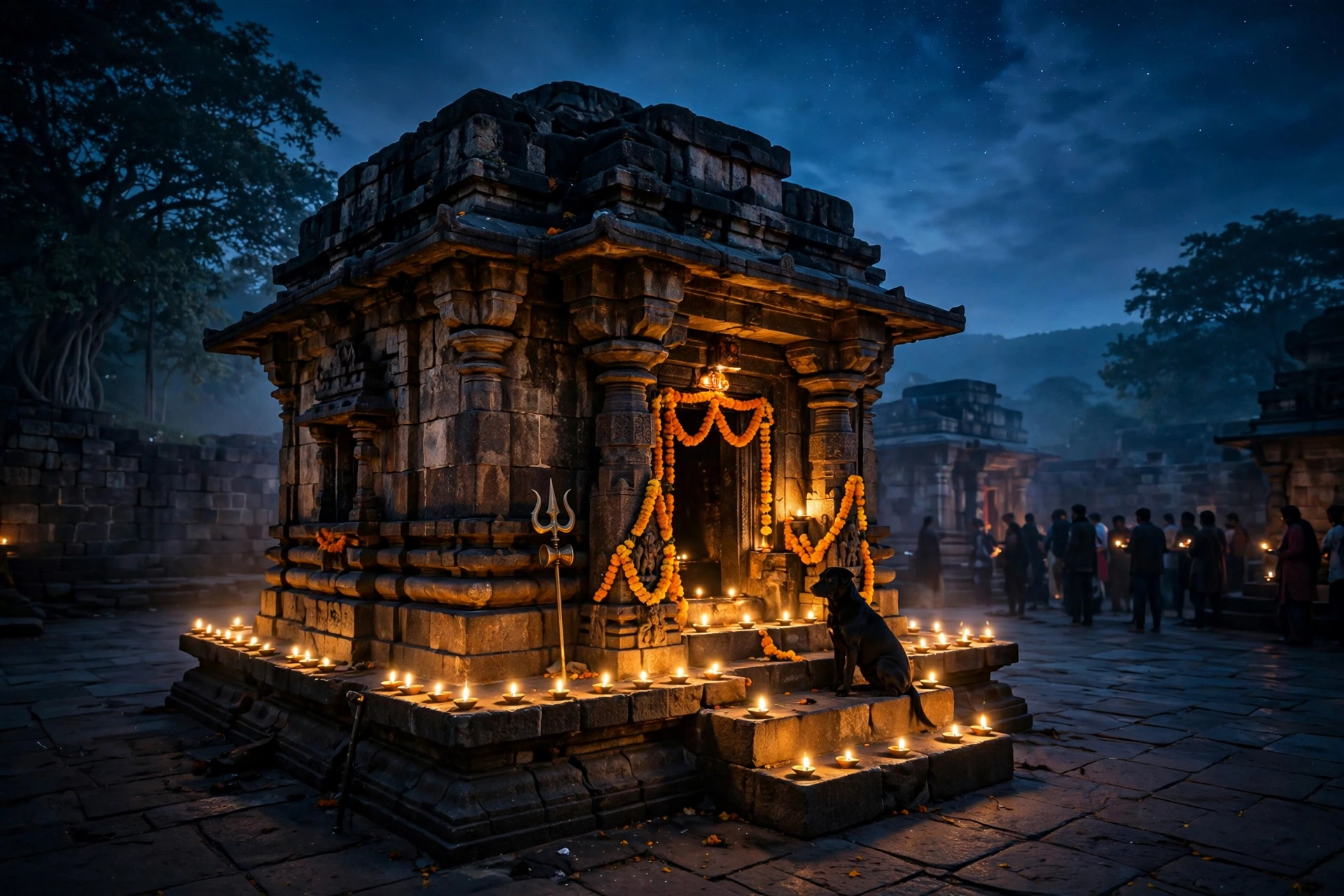
Kala Bhairav is the fierce, protective form of Lord Shiva. The name itself explains him: “Kala” means both time and death, and “Bhairava” means the terrible one, the one who removes fear. He is shown dark in colour, carrying a trident, a drum, a noose and a skull-bowl, with a dog as his vahana (vehicle). He is the Kshetrapala, the guardian deity of a holy place, and in Kashi (Varanasi) he is honoured as its Kotwal, the city’s guardian, whose permission pilgrims traditionally seek before visiting the other shrines. Shaiva tradition speaks of eight Bhairavas (Ashta Bhairava) guarding the directions, and Kala Bhairav is the best known of them. In many South Indian Shiva temples, a Bhairava shrine stands near the exit, and devotees pray there before leaving. Devotees worship him for protection from negative energies, for victory over enemies, and for freedom from fear.
The Story of Bhairava’s Appearance
This is a summary of a story told in the Shiva Purana and other Shaiva texts; details differ between tellings. Once, Brahma grew proud and claimed to be the highest of the gods, and his fifth head spoke words of contempt for Shiva. From Shiva’s anger a fierce form arose: Kala Bhairav. With his fingernail he cut off Brahma’s fifth head, humbling his pride. Since Brahma was a creator-god, the act carried the stain of a great sin, and the skull stuck to Bhairava’s hand.
Bhairava wandered the worlds as a mendicant, carrying the skull as his begging bowl. Only when he reached Kashi did the skull fall from his hand, at the place remembered as Kapala Mochana, “release of the skull”. Shiva then made him the guardian of Kashi. The story is read as a lesson that pride, even in a god, is cut down, and that even Bhairava accepted the discipline of penance.
How to Observe Kala Bhairav Jayanti at Home
The observance is simple and is done at home or at a temple in the evening and at night. Practices vary by family and region, so follow your family tradition.
Bathe and keep the day simple: Bathe in the morning and keep the day simple. Many devotees fast until the evening puja, or eat one sattvic meal. Fasting is optional. If you are pregnant, elderly, diabetic, unwell or on medication, eat normally and keep the day with prayer, or ask your doctor before you fast.
Evening and night puja: In the evening or at night, place a picture of Kala Bhairav or Shiva, or worship at a Shiva lingam. The main worship is during the Nishita Muhurta (11:43 PM to 12:38 AM in New Delhi). Offer three arghya (water offerings) to the Lord with mantras, as described in the Vrat Parichay and Shiva Rahasya.
Lamp and offerings: Light a lamp with mustard oil or sesame oil. Offer black sesame, flowers, bilva leaves, coconut and a simple sweet.
Chanting: Chant “Om Kalabhairavaya Namah” or “Om Namah Shivaya”, and recite the Kalabhairava Ashtakam, the hymn attributed to Adi Shankaracharya, or the Bhairav Chalisa.
Night vigil: Many families keep a night vigil (jagaran) with bhajans and the stories of Shiva, as Bhairava is worshipped at night.
Feed a dog: Feed a dog, Bhairava’s vahana, with chapati or simple food, and give food to someone in need. If you have no dog at home, you can donate to an animal shelter in the spirit of the custom.
What to Offer to Kala Bhairav
| Offering | Notes |
|---|---|
| Mustard oil or sesame oil lamp | Lit in the evening or during the Nishita Muhurta |
| Black sesame seeds | A traditional Bhairava offering |
| Flowers and bilva leaves | Offered at the shrine or Shiva lingam |
| Coconut and sweets | Jalebi or imarti in North India; vadas or curd rice in the South |
| Food for a dog | Chapati or simple food for Bhairava’s vahana |
| Food for someone in need | Given as charity after the puja |
Kalashtami Dates in November and December 2026
Every Krishna Paksha Ashtami, the eighth day of the waning moon, is kept as Kalashtami, a monthly day of Bhairava worship. Kala Bhairav Jayanti is the one Kalashtami of the year that marks his appearance day.
| Kalashtami | Date in India (Drik Panchang) | Note |
|---|---|---|
| Kartika Krishna Ashtami | Sunday, 1 November 2026 | Monthly Kalashtami |
| Margashirsha Krishna Ashtami | Tuesday, 1 December 2026 | Kala Bhairav Jayanti |
| Pausha Krishna Ashtami | Wednesday, 30 December 2026 | Monthly Kalashtami |
Kala Bhairav Jayanti Dates in Coming Years
| Year | دن | تاریخ |
|---|---|---|
| 2026 | منگل | 1 December 2026 |
| 2027 | ہفتہ | 20 November 2027 |
the 2027 date is the India reckoning from Drik Panchang (New Delhi). The Ashtami begins at 7:17 PM on Saturday, 20 November 2027 and ends at 5:19 PM on Sunday, 21 November 2027. Confirm the 2027 date with a local panchang closer to the time. See our Gita Jayanti 2026 guide for the next big December festival, our Utpanna Ekadashi 2026 guide for the Ekadashi three days later, and our Maghar page for the desi month in which Kala Bhairav Jayanti falls.
Frequently Asked Questions
When is Kala Bhairav Jayanti in 2026?
Kala Bhairav Jayanti 2026 is on Tuesday, 1 December 2026 in India, per Drik Panchang. The Krishna Paksha Ashtami tithi begins at 12:11 AM IST on 1 December and ends at 11:13 PM IST the same day.
What is the Nishita puja muhurat for Kala Bhairav Jayanti 2026?
In New Delhi, the Nishita Muhurta, the main night puja window, is 11:43 PM on Tuesday, 1 December 2026 to 12:38 AM on Wednesday, 2 December 2026. Bhairava is worshipped at night, so the main puja happens close to midnight, and many devotees keep a night vigil after it.
Is Kala Bhairav Jayanti on 30 November or 1 December outside India?
Because Bhairava is worshipped at night, the date outside India follows the Ashtami that covers local midnight. That is the night of Monday, 30 November 2026 in the USA, Canada, the UK and the UAE, and Tuesday, 1 December 2026 in Singapore, Malaysia and Australia. Many temples abroad hold the main puja on the day they announce, so check with your temple.
Who is Kala Bhairav?
Kala Bhairav is the fierce, protective form of Lord Shiva. “Kala” means both time and death, and “Bhairava” means the terrible one, the one who removes fear. He is the guardian (Kshetrapala) of holy places and is honoured as the Kotwal, the guardian, of Kashi (Varanasi). His vahana is the dog.
What should I offer to Kala Bhairav?
Families commonly offer a mustard oil or sesame oil lamp, black sesame, flowers, bilva leaves, coconut and sweets such as jalebi or imarti in North India, and vadas or curd rice in the South. Feeding a dog, Bhairava’s vahana, is a popular custom. Follow your family and temple tradition.
When is Kala Bhairav Jayanti in 2027?
Kala Bhairav Jayanti in 2027 falls on Saturday, 20 November 2027, in the India reckoning from Drik Panchang. The Ashtami begins at 7:17 PM on 20 November and ends at 5:19 PM on 21 November, so confirm the date with a local panchang closer to the time.