Lohri 2027: Date, Bonfire Timings, Rituals and Significance
Lohri is Punjab’s great winter bonfire festival, kept on the night before Makar Sankranti to mark the end of the coldest days and the start of longer days. Families gather around a fire at sunset, throw sesame, jaggery, peanuts and popcorn into the flames, and sing the ballad of Dulla Bhatti late into the night. In 2027, Lohri falls on Thursday, 14 January in India, while Punjab tradition and most calendars abroad keep it on Wednesday, 13 January. This guide gives both dates, the bonfire timings, the story behind the festival and how it is celebrated.
When Is Lohri in 2027?
Lohri 2027 is on Thursday, 14 January 2027 in India, according to Drik Panchang for New Delhi. Lohri is always kept on the evening before Makar Sankranti, and in 2027 the Sun enters Makara at 9:14 PM IST on Thursday, 14 January, after sunset, so Makar Sankranti falls on Friday, 15 January in India and Lohri falls on the evening of 14 January. In the Desi calendar, Lohri is the last day of Poh, the month that runs from 16 December 2026 to 14 January 2027, so 14 January 2027 is 30 Poh 2083 BS, and the next day, 15 January, is 1 Magh 2083 BS, the day of Maghi.
Many Punjabi families and calendars abroad keep Lohri a day earlier, on Wednesday, 13 January 2027. That is the traditional date, the eve of Makar Sankranti as kept in the UK, the USA and Canada, where the Sankranti moment falls in the daytime on Thursday, 14 January. The Nanakshahi calendar also fixes Maghi on 14 January, which puts Lohri on 13 January. The Rashtriya Panchanga lists Lohri on 13 January 2027 for Jammu and Kashmir. If your family follows the Punjab tradition, light the bonfire on the evening of 13 January; if you follow Drik Panchang for India, light it on the evening of 14 January. Either way, confirm the evening with your local panchang, gurdwara or family elders.
Lohri 2027 Date and Timings
The timings below follow Drik Panchang for New Delhi, India. Lohri has no scriptural muhurat of its own; by custom the bonfire is lit after sunset, and the family or the neighbourhood sets the time. Sunset times change from city to city, so check a local panchang for your exact time.
| تقریب | Date and Time |
|---|---|
| Lohri (India, Drik Panchang) | Thursday, 14 January 2027 |
| Lohri (Punjab tradition, UK, USA, Canada) | Wednesday, 13 January 2027 |
| Lohri Sankranti Moment | 9:14 PM IST, Thursday, 14 January 2027 |
| Makar Sankranti (India) | Friday, 15 January 2027 |
| Makar Sankranti (UK, USA, Canada) | Thursday, 14 January 2027 |
| Maghi (1 Magh 2083 BS) | Friday, 15 January 2027 |
| دیسی تاریخ | 30 Poh, 2083 BS (last day of Poh; 13 January is 29 Poh) |
| Bonfire | After sunset, around 5:45 PM in New Delhi |
| Previous Lohri | Tuesday, 13 January 2026 |
Bonfire Timings by City
The bonfire is lit once the sun has set, so the time follows local sunset. The times below are sunset times on Thursday, 14 January 2027. On Wednesday, 13 January, sunset is a minute or two earlier in each city.
| شہر | Sunset (14 January 2027) |
|---|---|
| نئی دہلی | 5:45 PM |
| امرتسر | 5:48 PM |
| چندی گڑھ | 5:43 PM |
| Jammu | 5:46 PM |
What Is Lohri?
Lohri is a winter harvest festival of Punjab, celebrated by Punjabi Hindus and Sikhs alike in Punjab, Haryana, Delhi, Himachal Pradesh and Jammu, and by Punjabi families around the world. It marks the end of the coldest part of winter and the harvesting of the rabi crops, wheat and sugarcane, and it welcomes Uttarayan, the Sun’s northward journey, when days begin to grow longer. The fire is the heart of the festival: it is a thanksgiving to Agni, the fire god, and to the Sun, and a prayer for warmth, prosperity and a good harvest in the year ahead. Unlike most Hindu festivals, Lohri is not tied to a lunar tithi. It follows the solar calendar, falling on the last day of the solar month of Poh, the eve of Maghi, which is why it lands on 13 or 14 January almost every year.
The Story of Dulla Bhatti
The most loved story of Lohri is the legend of Dulla Bhatti, a real folk hero of Punjab from the time of the Mughal emperor Akbar in the 16th century. Dulla Bhatti, whose full name was Abdullah Bhatti, was a Rajput rebel who defied Mughal taxation and became known as the Robin Hood of Punjab, robbing the rich to help the poor. He is remembered above all for rescuing poor girls who were being taken away to be sold, arranging their marriages with honour and paying their dowries from his own wealth. The two girls named most often in the songs are Sundri and Mundri, whom he saved and married off with dignity. Every Lohri, children and adults sing his ballad around the bonfire, beginning with the famous lines “Sundar Mundriye Ho, Tera Kaun Vichara Ho, Dulla Bhatti Wala Ho”, thanking him for his bravery and generosity.
How Lohri Is Celebrated
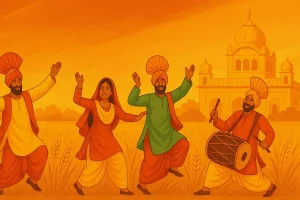
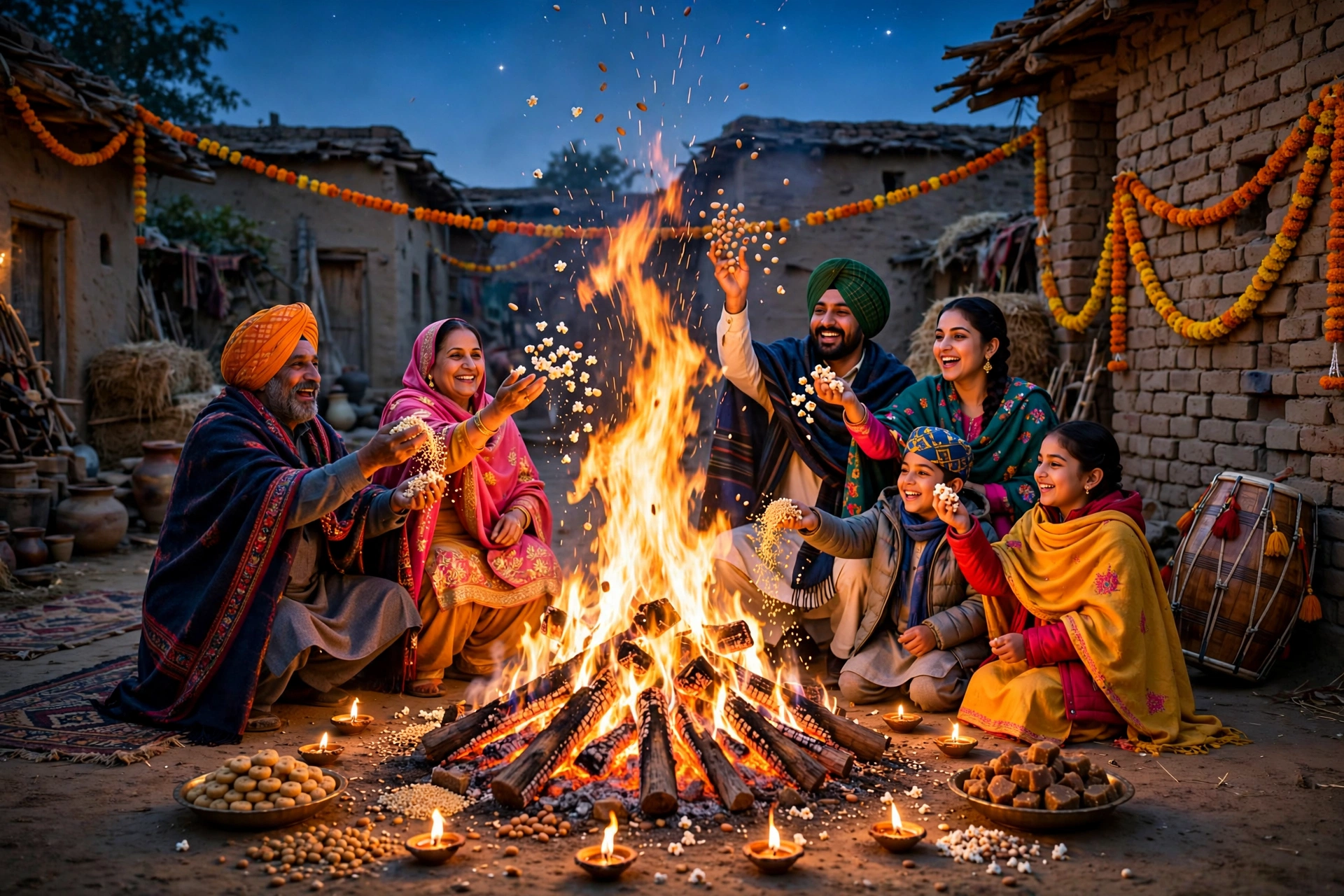
The celebration begins in the daytime, when children go from door to door singing Lohri songs and collecting small gifts of sweets, peanuts and money. In the afternoon, families stack wood and dried cow-dung cakes in the courtyard, the lane or the village square. Once the sun sets, the eldest member of the family, or the host of the fire, lights the bonfire. Everyone gathers around it and walks clockwise around the flames, throwing sesame, jaggery, rewari, peanuts and popcorn into the fire as offerings, while the songs of Dulla Bhatti are sung in chorus. The dhol starts, men dance bhangra and women dance giddha, and the celebration goes on late into the night. Families share the roasted offerings as prasad and feast together on sarson da saag and makki di roti, the winter food of Punjab. The next morning is Maghi, when many families visit the gurdwara or temple, take a holy dip and give food and clothes to the poor.
What Is Offered into the Fire?
Everything thrown into the Lohri fire comes from the winter harvest, and each offering carries a meaning: gratitude for the crop and a prayer for plenty in the year ahead.
| نذرانہ | مطلب |
|---|---|
| Til (sesame seeds) | The first of the winter harvest, offered for warmth and prosperity |
| Gur (jaggery) | Sweetness in the new year, and the taste of the sugarcane harvest |
| Rewari and gajak | Sesame and jaggery sweets, shared as prasad after the fire |
| Peanuts (moongphali) | The winter crop, roasted in the fire and eaten warm |
| Popcorn (phullian) | Offered for abundance, and scattered for children to catch |
First Lohri: Newborns and Newlyweds
A family’s first Lohri is a special occasion. When a baby is born, or a couple marries, during the year, the family hosts its first Lohri with extra grandeur, inviting relatives and neighbours, sending sweets around and taking gifts. The new parents or the newlywed couple sit closest to the fire, and the songs sung for them carry blessings for the child’s health and the couple’s happiness. It is also customary for the family celebrating its first Lohri to distribute rewari, peanuts and jaggery to everyone who gathers. For many Punjabi families abroad, the first Lohri is the moment a child born far from Punjab is welcomed into the family’s traditions.
Lohri Dates in Coming Years
| سال | دن | تاریخ |
|---|---|---|
| 2026 | منگل | 13 January 2026 (previous) |
| 2027 | جمعرات | 14 January 2027 (India); Wednesday, 13 January 2027 (Punjab tradition and abroad) |
| 2028 | جمعہ | 14 January 2028 |
| 2029 | ہفتہ | 13 January 2029 |
| 2030 | اتوار | 13 January 2030 |
Note: the dates above follow Drik Panchang for New Delhi, which keeps Lohri on the evening before Makar Sankranti as reckoned for India. In years when the Sankranti moment falls late in the day, some Punjab calendars keep Lohri a day earlier, on 13 January. Confirm the date with a local panchang closer to the time. See our Vaisakhi 2026 guide for Punjab’s spring harvest festival, our گرپرب 2026 گائیڈ for Guru Nanak Jayanti, and our ماگھر صفحہ for the Desi month that leads into Poh.
اکثر پوچھے جانے والے سوالات
When is Lohri in 2027?
Lohri 2027 is on Thursday, 14 January 2027 in India, according to Drik Panchang for New Delhi. Many Punjabi families and calendars in the UK, USA and Canada keep it a day earlier, on Wednesday, 13 January 2027. Makar Sankranti falls on Friday, 15 January in India and on Thursday, 14 January abroad.
Why do some calendars say 13 January and others 14 January for Lohri 2027?
Lohri is kept on the evening before Makar Sankranti, and in 2027 the Sun enters Makara at 9:14 PM IST on Thursday, 14 January, after sunset in India, so Drik Panchang puts Makar Sankranti on 15 January and Lohri on 14 January in India. Abroad, the same moment falls in the daytime on 14 January, so Sankranti is 14 January and Lohri is 13 January. The Nanakshahi calendar also fixes Maghi on 14 January, which puts Lohri on 13 January.
At what time is the Lohri bonfire lit?
The bonfire is lit after sunset, around 5:45 PM in New Delhi, 5:48 PM in Amritsar, 5:43 PM in Chandigarh and 5:46 PM in Jammu on 14 January 2027. Lohri has no fixed scriptural muhurat; the family or the neighbourhood sets the time once the sun has set.
Who was Dulla Bhatti?
Dulla Bhatti, or Abdullah Bhatti, was a 16th-century Punjabi Rajput rebel from the time of the Mughal emperor Akbar, remembered as the Robin Hood of Punjab. He robbed the rich to help the poor and is celebrated for rescuing girls who were being taken away to be sold, arranging their marriages and paying their dowries. The Lohri song “Sundar Mundriye” tells his story.
What is offered into the Lohri bonfire?
Sesame seeds (til), jaggery (gur), rewari and gajak, peanuts and popcorn are thrown into the flames as offerings from the winter harvest. They are then shared as prasad. Families also feast on sarson da saag and makki di roti, the winter food of Punjab.
What is first Lohri?
First Lohri is the first Lohri celebrated after a baby is born or a couple marries in the family. The family hosts the bonfire with extra grandeur, invites relatives and neighbours, sends sweets around and takes gifts, with songs and blessings for the child or the newlywed couple.