Christmas 2026: Date, History and Celebrations in India
Christmas is the festival that closes the year in India, celebrated on 25 December to mark the birth of Jesus Christ. Churches fill for midnight Mass on Christmas Eve, homes glow with stars and trees, and families gather for plum cake, carols and gifts. In 2026, Christmas falls on Friday, 25 December, a gazetted national holiday that gives India a three-day weekend. This guide gives the date, the holiday details, the history of the festival and how it is celebrated across India, from Goa to Kerala to the Northeast.
When Is Christmas in 2026?
Christmas 2026 is on Friday, 25 December 2026. The celebrations begin the evening before, on Christmas Eve, Thursday, 24 December, when midnight Mass is held in churches across the country. In the Desi calendar, Christmas falls in the month of Poh, which runs from 16 December 2026 to 14 January 2027, so 25 December 2026 is 10 Poh 2083 BS. The day after Christmas, Saturday, 26 December, is Boxing Day in the UK and Commonwealth countries. New Year’s Day follows a week later, on Friday, 1 January 2027.
Christmas 2026 Date and Holiday Details
| Event | Date and Time |
|---|---|
| Christmas Eve | Thursday, 24 December 2026 |
| Christmas Day | Friday, 25 December 2026 |
| Boxing Day | Saturday, 26 December 2026 |
| Desi date | 10 Poh, 2083 BS (Poh runs 16 December 2026 to 14 January 2027) |
| Holiday status | Gazetted national holiday, all India |
| Banks | Closed across India on 25 December; also closed 26 December (fourth Saturday) |
| Government offices and schools | Closed on 25 December |
| Long weekend | Friday 25 to Sunday 27 December 2026 (three days) |
| Christmas Eve (restricted holiday) | Central government offices in Delhi and New Delhi; banks closed in Aizawl, Kohima and Shillong |
| Extended holidays | 24 to 27 December in Nagaland, Meghalaya and Mizoram |
| New Year’s Day 2027 | Friday, 1 January 2027 |
| Previous Christmas | Thursday, 25 December 2025 |
What Is Christmas?
Christmas celebrates the birth of Jesus Christ, and it is one of the oldest and most widely observed festivals in the world. The date of 25 December was fixed in the fourth century, in Rome, and the first recorded Christmas celebration on that date took place in 336 AD. The festival grew over the centuries as Christian traditions spread across Europe and then around the world. The Christmas tree comes from Germany, where families began decorating evergreen trees in the 16th century; the custom became popular in Britain in the 19th century. Santa Claus comes from Saint Nicholas, a fourth-century bishop of Myra remembered for his secret gifts to the poor, whose story travelled through Dutch and English traditions into the figure children wait for today. Carols, the singing of Christmas songs, go back to medieval Europe, when groups sang in the streets and in churches during the winter season. Midnight Mass, the service held late on Christmas Eve, is one of the oldest parts of the celebration, marking the moment of the birth at the start of Christmas Day.
How Christmas Is Celebrated in India
India has celebrated Christmas since the arrival of the Portuguese in Goa in the 16th century, and today it is kept with warmth by Christian communities and enjoyed as a festival by people of all faiths. Churches hold midnight Mass on Christmas Eve, usually late in the evening, followed by carol singing, and families return home to a feast. The exact Mass timings vary from church to church, so check with your local church closer to the day.
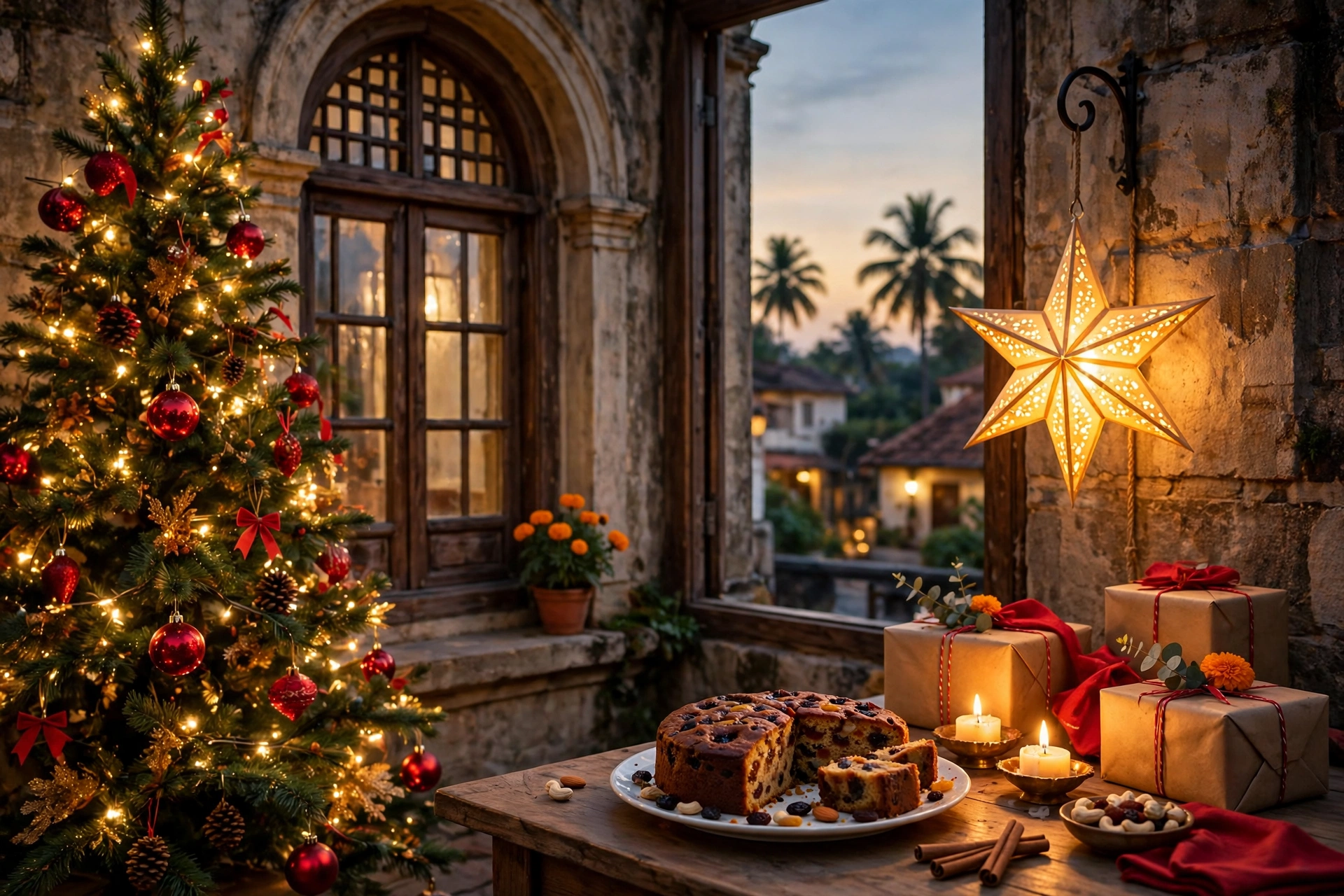
Goa keeps the grandest Christmas in India. Churches in Old Goa and across the state are lit up, cribs showing the nativity scene are set up in homes and squares, and families prepare kuswar, the tray of Goan Christmas sweets. Kerala’s Syrian Christian families hang glowing paper star lanterns outside their homes, bake rich plum cake, and attend midnight Mass. In the Northeast, Shillong, Kohima and Aizawl celebrate with carols, church services and lights across the towns, and the states observe extended holidays around Christmas. In Mumbai, the suburb of Bandra lights up with stars and cribs, and Kolkata’s Park Street glows with Christmas lights and markets through the season. In Punjab, churches in Amritsar, Ludhiana and Jalandhar hold midnight Mass and carol services, and Christian families celebrate with cake, gifts and family meals. Across India, schools and offices hold Christmas parties in the week before, malls put up trees, and plum cake becomes the cake of the season.
Christmas Traditions and Symbols
| Symbol | Meaning |
|---|---|
| Christmas tree | An evergreen decorated with lights and ornaments, a sign of life through winter |
| Star on the tree | The Star of Bethlehem that guided the wise men to the birthplace |
| Santa Claus | From Saint Nicholas, who gave gifts in secret; children receive gifts in his name |
| Carols | Christmas songs sung in churches, homes and streets through the season |
| Crib (nativity scene) | A display of the birth of Jesus in the stable, set up in churches and homes |
| Plum cake | The rich fruit cake baked for Christmas in India, shared with family and neighbours |
| Star lantern | A glowing paper star hung outside the home, a sign of the Star of Bethlehem |
| Mistletoe and holly | Winter greenery used in decoration, a symbol of goodwill and the season |
Is Christmas a Public Holiday in India?
Yes. Christmas Day is one of the gazetted holidays notified every year by the Department of Personnel and Training, and in 2026 it falls on Friday, 25 December. Central government offices, state government offices, schools and banks are closed across India on the day, and most corporate offices also give the day off. Because it falls on a Friday, the holiday runs into the weekend, giving a three-day break from Friday 25 to Sunday 27 December, and Saturday 26 December is the fourth Saturday, which is a bank holiday in any case.
Most of daily life goes on as usual. Shops, restaurants, malls, cinemas and public transport run normally on Christmas Day in most cities, and only banks and government offices shut nationwide. One exception is worth knowing if you are travelling: the Taj Mahal is closed to visitors every Friday, so it is closed on 25 December 2026, while Agra Fort and Fatehpur Sikri stay open. Christmas Eve, Thursday, 24 December, is a restricted holiday for central government offices in Delhi and New Delhi, and banks are closed that day in Aizawl, Kohima and Shillong. In Nagaland, Meghalaya and Mizoram, the Christmas holidays run from 24 to 27 December.
Christmas Dates in Coming Years
| Year | Day | Date |
|---|---|---|
| 2025 | Thursday | 25 December 2025 (previous) |
| 2026 | Friday | 25 December 2026 |
| 2027 | Saturday | 25 December 2027 |
| 2028 | Monday | 25 December 2028 |
| 2029 | Tuesday | 25 December 2029 |
| 2030 | Wednesday | 25 December 2030 |
Christmas always falls on 25 December, so only the weekday changes from year to year. In 2027 it falls on a Saturday, and in 2028 on a Monday. See our Lohri 2027 guide for the next big winter festival after Christmas, our Gurpurab 2026 guide for Guru Nanak Jayanti, and our Maghar page for the Desi month that leads into Poh.
Frequently Asked Questions
When is Christmas in 2026?
Christmas 2026 is on Friday, 25 December 2026. Christmas Eve is Thursday, 24 December, when midnight Mass is held in churches, and Boxing Day is Saturday, 26 December. In the Desi calendar, 25 December 2026 is 10 Poh 2083 BS.
Is Christmas a public holiday in India?
Yes. Christmas Day is a gazetted national holiday in India, so central and state government offices, schools and banks are closed across the country on 25 December 2026. Most corporate offices also give the day off. Shops, restaurants and public transport mostly run normally.
Are banks closed on Christmas 2026?
Yes, banks are closed across India on Friday, 25 December 2026 for Christmas. Banks are also closed on Saturday, 26 December, which is the fourth Saturday of the month, and on Sunday, 27 December. Banks in Aizawl, Kohima and Shillong are also closed on Christmas Eve, Thursday, 24 December.
Is there a long weekend for Christmas 2026?
Yes. Christmas falls on a Friday in 2026, so it gives a three-day weekend from Friday, 25 December to Sunday, 27 December. In Nagaland, Meghalaya and Mizoram the Christmas holidays run from Thursday, 24 December to Sunday, 27 December.
What time is midnight Mass on Christmas Eve?
Midnight Mass is usually held late on Christmas Eve, 24 December, often starting around 11 PM and running past midnight into Christmas Day, but the exact time varies from church to church. Check the timings with your local church closer to the day.
How is Christmas celebrated in India?
Christmas in India is celebrated with midnight Mass, carol singing, cribs, star lanterns, Christmas trees and plum cake. Goa keeps the grandest celebrations with kuswar sweets and lit-up churches, Kerala hangs star lanterns and bakes plum cake, and the Northeast towns of Shillong, Kohima and Aizawl celebrate with carols and lights. People of all faiths join in the season with parties, gifts and family meals.